
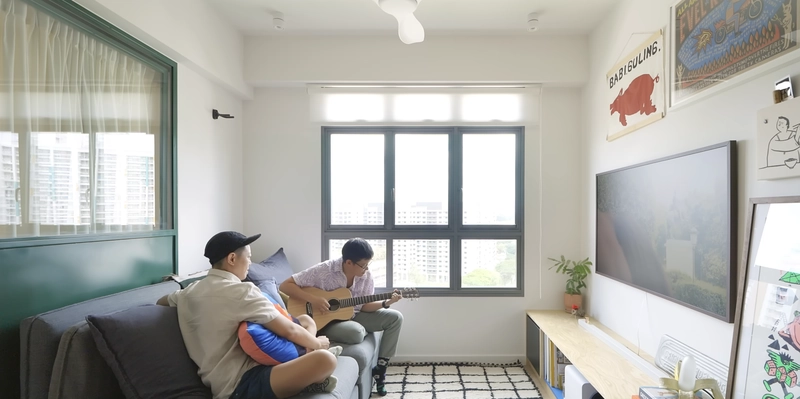
NEVER TOO SMALL: Clever Spaces in an Illustrator’s Vibrant Apartment, Singapore 47sqm/506sqft
In the contemporary urban landscape, architecture is no longer just about building structures; it is about redefining the boundaries of limited space to enhance the quality of modern living. As architects, we increasingly look toward a philosophy of precision, where a home functions with the versatility of a Swiss Army knife—compact, functional, and well-designed to transform effortlessly based on the inhabitant’s needs.
The Art of Spatial Efficiency
Modern living, particularly in high-density urban areas like Singapore, demands extreme spatial efficiency. We see this in the way a mere 47-square-meter apartment can be reconfigured to feel expansive. By making strategic structural changes—such as shifting a kitchen wall by just 20 centimeters or replacing traditional swinging doors with steel and glass sliding doors—we can introduce natural light and create a more open flow.
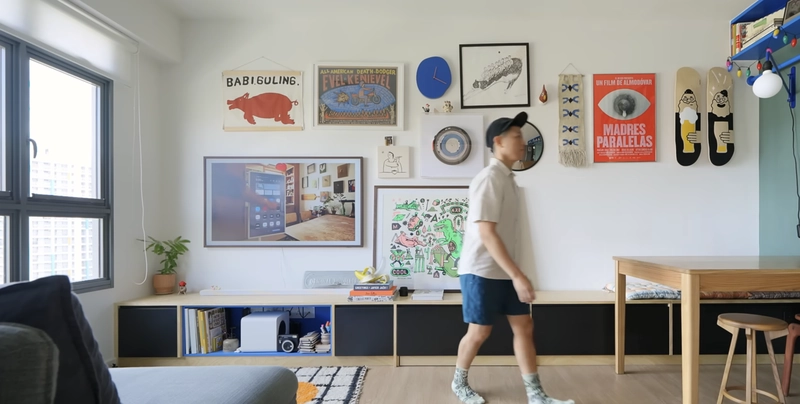
Efficiency is also found in multi-functional “Side Hustle Furniture” that serves dual purposes without sacrificing aesthetics. For instance, a custom shoe rack can double as a foyer bench, while a long plywood bench can simultaneously function as seating, storage, and a TV console. Even the smallest details, such as a hexagon-shaped shower screen, are designed to maximize floor space by ensuring the door does not obstruct the room when opened.
Sustainable and Refined Materials
The choice of materials in modern architecture serves both a functional and an emotional purpose. We are seeing a shift toward recycled plastic and plywood to create bespoke furniture that is both sustainable and full of personality. To ensure longevity and ease of maintenance in a high-use environment, architects are utilizing fingerprint-resistant laminates and matte-varnished veneers, which add warmth and a sense of “effortless refinement” to a space. Furthermore, materials like glossy tiles and mirrors are used strategically to reflect light, effectively making smaller rooms appear larger and more inviting.
Architecture as a Respite: The Nature Connection
Even in a 25-story public housing project, architecture must facilitate a connection to nature to provide a respite from the “busyness of the city”. This is often achieved through a “nature-inspired” color palette—such as using specific shades of green in a foyer to evoke calmness—and the maximize-use of natural light through glass partitions. By integrating these elements, the home becomes more than a shelter; it becomes a sanctuary.
Ultimately, good design proves that a small footprint is not a limitation but a desirable foundation for intentional living. When every object and piece of art is a “conscious decision,” the architecture becomes a true expression of the inhabitant’s identity.
Architecture in the modern age is like a well-tailored suit; it is meticulously measured and cut to fit the specific movements of the individual, ensuring that not a single inch of fabric—or space—is wasted.